
This page has news from the nursery. You can find copies of recent newsletters here, as well as information about new plants added to the nursery stock.
1 Apr 2011
Sorry for the break in news... The new Autumn 2011 newsletter is now available.
26 Jan 2011
Two new plants are now in stock. Mentha australis is a rare and endangered herb from riversides in nothern Tasmania. Its strongly scented - pepperminty - leaves can be used to make a tonic, or as a garnish in salads. Aboriginals used an extract of boiled leaves for coughs and colds. The plant likes a damp spot, but can be invasive, so therefore is probably best in a pot. A word of caution: there is some suggestion that ingestion of large amounts of members of this genus can cause abortions, so pregnant women should take care.
The other new plant is Vittadinia muelleri, an attractive, purple-flowered daisy that occurs in the midlands and the dry hills around Hobart. This species is also rare. However, it seeds readily and can spread in the garden.
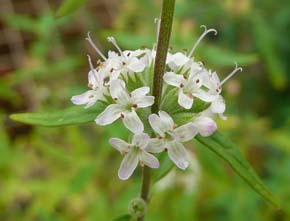
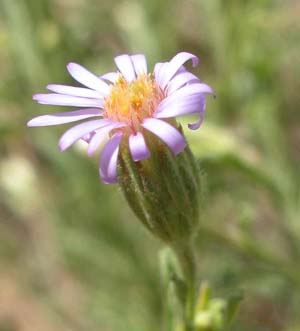
Mentha australis (left) and Vittadinia muelleri (right). Photos copyright Greg Jordan
http://www.utas.edu.au/dicotkey/dicotkey.htm
31 Dec 2010
We have just put out new stock of two our favourite plants that are rarely available - Spyridium vexilliferum (Propeller Plant) and Astroloma pinifolium (Pine Heath). Stocks of both are limited, so get in quick!
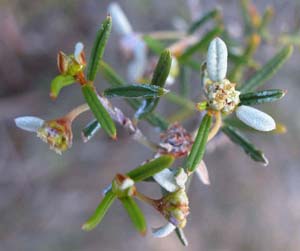
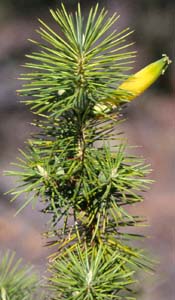
Propeller Plant (left) and Pine Heath (right). Photos copyright Greg Jordan
http://www.utas.edu.au/dicotkey/dicotkey.htm
20 Dec 2010
The nursery will be closed on Christmas and Boxing Days, but will be open again on Monday 27th December. We'll also be open New Year's Day (we have to water the plants, so might as well be here for customers as well!)
Happy Christmas and a prosperous New Year to all our customers (and anyone else that finds this webpage!) from all at Plants of Tasmania Nursery.
15 Dec 2010
A scientific paper has just been published that looks at the genetics of Tasmanian and mainland examples of Hardenbergia violacea, or the Purple Coral Pea. This species, which is grown in many gardens throughout Australia, is very rare in Tasmania. It is found on two dry, rocky hillsides near Richmond. Given this rarity, it had been suggested that these may have been just garden escapees. Now the truth is out: plants from these populations are distinctly different to those in Victoria and NSW. The conclusion that is drawn from the data is that the Tasmanian population was probably a result of a range expansion of the mainland form in a period when Tasmania was attached to the mainland during an ice-age. When the land bridge was broken, the Tasmanian population diminished to the small area it now occupies. The separation from mainland plants has allowed further genetic drift (ie evolution) to occur.
The researchers also sampled plants from our nursery, and we can now gaurantee that the plants we sell have a Tasmanian provenance (not that we doubted this!) We grow this species from cuttings, so there is no chance of 'foreign' pollen creating plants of mixed origin.
9 Dec 2010
We are pleased to have this one out for the first time: not a spectacular plant, but an important one. It is rare in Tasmania, but prior to European settlement was a major food source for the aboriginal inhabitants. Cattle, sheep and cultivation have reduced its ditribution markedly. The plant develops a thick, tuberous root that can be roasted. Click here for a taste test from someone who roasted it (there are also comments on when to harvest it), and here for the results of a BBQ test. It turns out that the nearest relative to the Yam Daisy grows in western North America! The daisies are $2.85 each in forestry tubes.
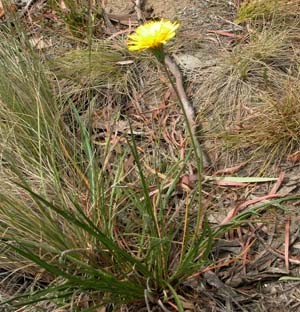
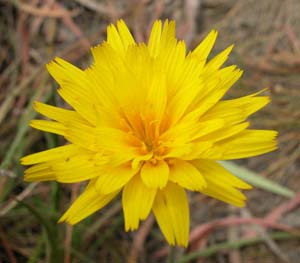
Microseris lanceolata - plant and flower. Photos copyright Greg Jordan
http://www.utas.edu.au/dicotkey/dicotkey/AST/cichorioids/gMicroseris.htm
4 Dec 2010
NRM South has produced a series of pamphlets listing plants suitable for each of the southern Tasmanian municipalities. The pamphlets list plants for particular soil types, which is very useful. They also list plants for different locations - wet, dry, coastal etc. The pamphlets are available here. There are also new lists of plants suitable for hedges and fire-resistant plants available.
26 Nov 2010
Another new plant for us has just gone out into sales. Ranunculus prasinus is a very rare, threatened endemic herb from the Tasmanian midlands, where it grows in marshy areas next to salt lagoons. At the moment we have it labelled as Midlands Buttercup (the official common name), but it is also known as Tunbridge Buttercup. Like most buttercups, it has attractive yellow flowers. Follow this link for more information from the Tasmanian Parks service. This little plant needs a moist site in full sun - we have put it out into our water/bog plants area. Like all new plants we put out, any feedback on how they grow in gardens will be greatly appreciated.
19 Nov 2010
We now have stock of this most interesting new book. While it is ostensibly a reference book that gives the meaning of all Tasmanian plant names, it is so much more. There is information about may of the important players in Tasmanian botany from the early days to now, as well as a full pronunciation guide (though there are a few plants that we might not change how we pronounce just yet). Perfect for Christmas!
13 Nov 2010
New season's plants are starting to appear in sales - the cool spring has slowed things down considerably. We've just put out Gonocarpus teucrioides, a new plant for us. We grew a batch of this species for a revegetation job, and thought we'd put some out in sales as well. It is a small (30-50 cm), multi-stemmed understorey plant from damper forests. The easiest place to see it around Hobart is on Knocklofty, in particular on the track that heads off from the end of Poets Rd. Look up on the slope on the right hand side as you climb up the hill.
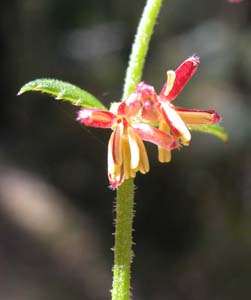
Male flowers of Gonocarpus teucrioides - photo copyright Greg Jordan
http://www.utas.edu.au/dicotkey/dicotkey/Halorag/sGonocarpus_teucrioides.htm
21 Oct 2010
A new plant going out into sales is Cyphanthera tasmanica (Tasmanian Rayflower). This is a rare and unusual species from the east coast that will do well in dry conditions. For more information, check out the DPIWE listing.
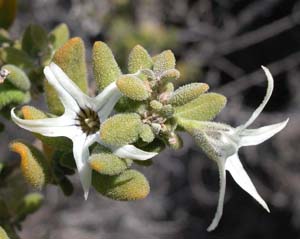
Cyphanthera tasmanica - photo copyright Greg Jordan
(http://www.utas.edu.au/dicotkey/dicotkey/SOLAN/gCyphanthera.htm)
21 Oct 2010
We all seem to have survived the last few weeks (see below). The Plant Hunters' Fair last Saturday was a day to remember - cold but calm, with regular snow showers drifitng down. Since then spring seems to have set in, and with that we are now starting to put out new stock into the sales area. Forms of Veronica formosa are already out, and today I'll put out one of our special plants, Comesperma volubile, or Blue Love Creeper. We are one of the few nurseries that grows this beautiful and ethereal plant. I am also putting out a new form of Billardiera longiflora that is quite vigorous and has fat, white berries (often with a hint of mauve). This form turned up in a chance seedling in another plant purchased by one of the staff. We still stock forms with purple, blue, red and standard white berries. Look out for other new forms of Billardiera soon.
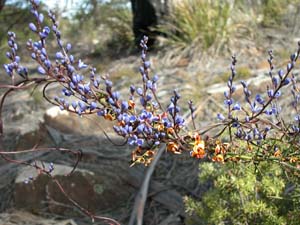
Comesperma volubile - photo copyright Greg Jordan
(http://www.utas.edu.au/dicotkey/dicotkey/OTHERS/sComesperma_voubile.htm)
4 Oct 2010
The nursery will have a stall and display at the Hobart Wildflower Show, to be held on Friday 8th -Sunday 10th October at the Hobart City Hall. There will be many displays at the show highlighting the joy of native plants. We will also have a stall at the Plant Hunters’ Special Plant Fair, held every second year at 1115 Huon Rd Neika (4.5 km past Fern Tree). This is a gathering of smaller Tasmanian nurseries selling hard to find or propagate plants. We will have an interesting selection of plants, including many unusual alpine and rainforest species.
1 Oct 2010
Our new newsletter for Spring 2010 is now available. Read about news from the nursery, an article about Tasmanian Melaleuca, new titles in the bookcase and a new type of tree guard. On the topic of newsletters, we hope to have all Will Fletcher's newsletters available here soon. These newsletters have a wealth of information, and having them available will provide lots of interesting browsing.
20 July 2010
We have just put out new stock of this beaut little alpine daisy bush. Check out the flowers here - they really make this plant. It's slow growing, but will be rewarding for the patient gardener with a cool, well-drained, moist spot in the garden (or a pot).
9 July 2010
It is always a thrill for us to offer a new species for sale. For us, propagating something new might be a challenge or might be easy, with finding plants in the first place more the problem. Cuttings of our new plant - Atriplex paludosa, or the Marsh Saltbush - were collected by a staff member near South Arm. Salt bushes generally strike quite well, and this one was no exception. The plant should do well in all coastal situations, and also in well-drained conditions elsewhere. Like its relative Atriplex cinerea, the blue-green leaves provide an interesting colour contrast in the garden.
If you put this plant into your garden we would like to get feedback on how it performs, so that we can pass information on to other customers in the future.
Other new-ish plants over the last year have included Einadia nutans, another seaside specialist; Tetracarpaea tasmannica, or Delicate Laurel, an alpine plant rare in cultivation, and Tasmania's newest Eucalypt species, Eucalyptus nebulosa, from near Tullah on the west coast.
8 June 2010
There is always a lot of interest in edible native plants,perhaps better known at Bush Tucker. We are in the process of developing a new area dedicated to these plants. For those of you who know the nursery it is in the area that used to house the bonsai. If it is your first visit, ask a staff member. At present we have lots of edible plants in the area, but as yet no signage and information about what bits you can eat. Until we get that organised, print out a copy of the Edible Plants page before heading to the nursery to guide you through the plants available. We hope to have the area up and running properly after a few other major behind-the-scenes jobs are finished, probably in August, all ready for spring.